
What Is the Best Time of Year to Build an Extension?
The month that suits the concrete is not the month most people start ringing round in, and the gap between the two is about six months.
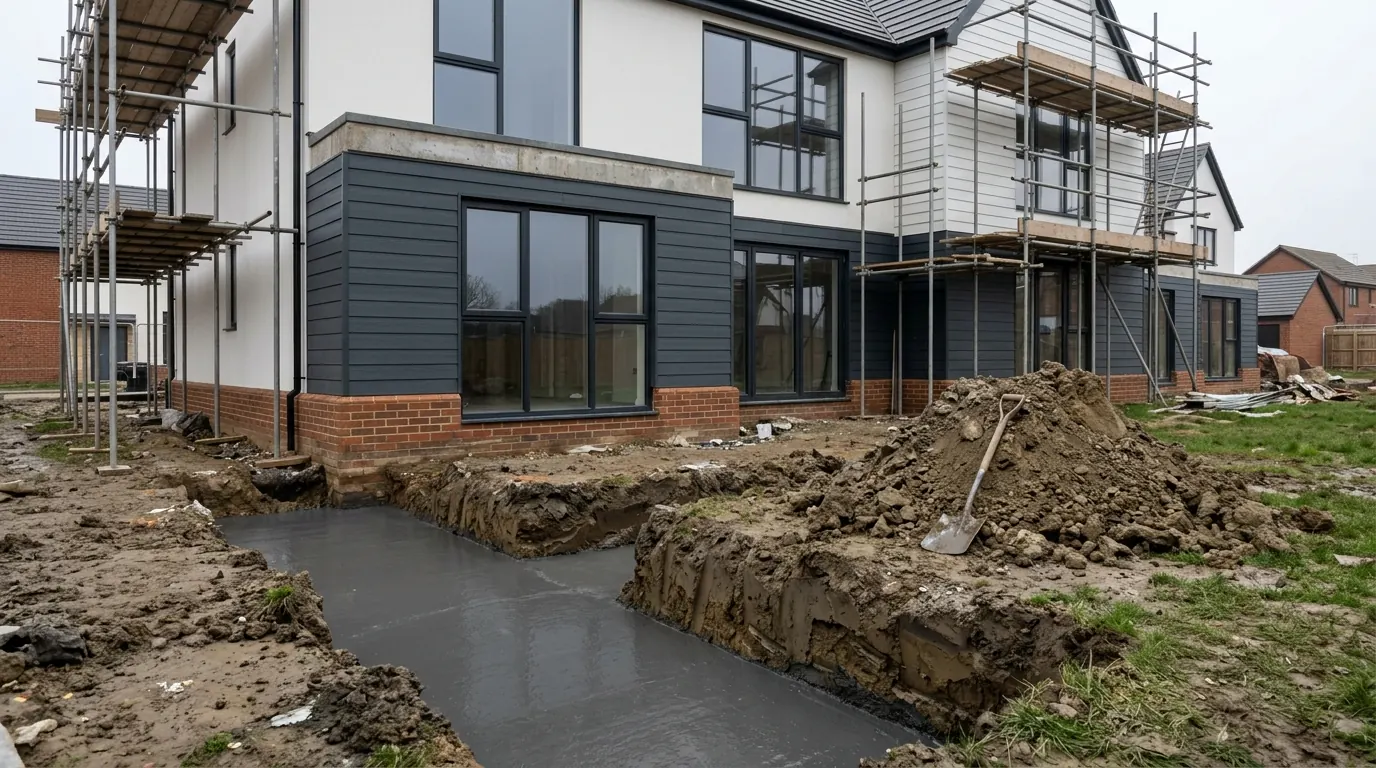
The best time to break ground on an extension is between April and early June, which means starting the drawings and any planning application the previous autumn. The worst month to start is October rather than January, because an autumn start puts the dig in wet ground and then leaves the plaster and screed to dry out in a cold house months later. Winter is good for paperwork and poor for concrete: statutory periods run through Christmas unchanged, while mortar stops gaining strength properly at around three degrees. Garage and loft conversions are close to season proof, because neither has a dig or a long period of open structure.
Break ground between April and early June, which means starting the paperwork the previous autumn. The worst month to start is not January, as most people assume. It is October.
An autumn start puts the two seasonal problems at opposite ends of the same job: the dig happens in wet ground, and the wet trades finish months later in a cold house that will not dry. A January start takes the harder groundworks and then walks into spring for everything that follows.
| Break ground | The dig | Everything after it |
|---|---|---|
| October | Wet ground | Plaster and screed drying in a cold shell, so it pays twice |
| January or February | The hard part, taken first | Easier by the week, so it pays once |
| April to early June | Workable ground | A dry summer ahead of the wet trades |
The season only touches part of the job
Weather exposure is not spread across a build. It attaches to concrete, mortar and mud, and all three sit at the front.
Once the roof is on and the openings are closed, the sky stops appearing in the programme. What rain and frost actually do to a build is covered in detail elsewhere, so the question here is narrower: given that the exposure is front loaded, which month should the front of the job land in.
Three things change measurably through the year, and only one of them is rain.
Daylight, temperature and ground
Daylight is the one nobody prices. At this latitude there are under eight hours of it around the winter solstice and more than sixteen in late June. In the first week of January a site loses its light before four in the afternoon, which is not a full working day with an hour of tidying up in it. That is not a delay anybody reports. It is simply fewer hours per week for a fixed amount of work.
Temperature sets hard limits rather than soft ones. Mortar stops gaining strength properly at around three degrees, and a hard frost on green mortar means taking the work down and laying it again. Ready mixed concrete is specified with a minimum temperature at delivery, commonly five degrees, and pouring into a frozen trench is not a judgement call. Protection is routine and it works, but on a genuinely cold morning the sensible decision is often not to lay at all.
Ground is the third, and around Colchester it is the most consequential. Shrinkable clay that is workable in May is a different material in February. Saturated, it will not take a tracked machine or a barrow run without boarding out, the trench sides soften, and the bottom needs trimming back to firm ground before concrete can go anywhere near it. Everything still gets done. It simply takes longer and costs more in access protection.
The fortnight the whole industry disappears
A programme running through late December loses more than the bank holidays.
Sites close for around two weeks. So do builders merchants, and steel fabricators and joinery shops often close for longer, which matters because those are the made to measure items a programme already waits on. Building Control inspection availability thins out across the same period, and an inspection that cannot happen is work that cannot be covered.
The statutory clocks are the exception, and they run in your favour. The eight week determination period is calendar time and does not pause for Christmas, so an application validated in the first week of December is decided in the first week of February. Winter is genuinely good for paperwork and genuinely bad for concrete, which is the whole argument on this page in one sentence.
Why an autumn start is the expensive one
Work backwards from the finish rather than forwards from the start. A build that breaks ground in October is weathertight around the turn of the year, which sounds fine. The problem is what comes next.
Plaster and screed both have to give up their water before anything goes on top of them, and both do it far more slowly in a cold, unheated, freshly built shell than in a warm one. Laying a floor over a screed that has not finished drying causes an expensive problem eighteen months later, so the honest response is to wait, and waiting in February takes longer than waiting in June. An autumn start therefore pays twice: once for the wet dig, and again for a drying period that lands in the worst possible weeks.
A February start pays once. The groundworks are the hard part, and everything after them gets easier by the week.
Working backwards to a spring start
For a job needing a full application, an April or May start on site means the following, roughly:
- September and October. Survey, measured drawings, decisions about the scheme while there is time to change your mind cheaply.
- November. Application submitted, with the structural design and any party wall notices running alongside rather than behind it.
- January. Decision, and any pre-commencement conditions dealt with immediately rather than in March.
- February and March. Building Regulations settled, steel and glazing ordered off approved calculations.
- April or May. Break ground, with a dry summer ahead of the wet trades.
The other reason to be doing that in autumn is availability. Anyone worth having is working on something already, and the diary for a spring start is filled over the winter. By the time the weather turns pleasant enough to make people ring round, the person they wanted has been booked since January. Asking when a job could start is a more useful question at that stage than asking what it costs.
Where none of this applies
Two of the commonest projects are close to season proof, and it is worth knowing which.
A garage conversion happens inside an existing building with its own roof already on. There is no dig, no scaffold and no period of open structure, so February is as good a month as July. A loft conversion is nearly as insulated from the calendar: the only exposed stage is the few days the roof is open to form the dormer, and that is short enough to work around a forecast rather than a season.
If the calendar is the constraint and the brief could go either way, that is a genuine argument for building upwards or inwards rather than outwards.
The answer that beats the month
Season is worth a few weeks. The right builder, free at the right time, with the paperwork already in hand, is worth considerably more than that, and a job that starts in February with everything settled will finish before one that starts in May with conditions still to discharge.
So treat the season as a tiebreak rather than a plan. Decide what you are building over the winter, have the permissions and the calculations in your hand by March, and take the first sensible start date after that. The full sequence from survey to certificate sets out which of those weeks are fixed in law and which are yours to move.
Programme observations here are typical for the Colchester area at the review date below, and a mild winter or a wet spring will move them.
Last reviewed August 2026.
Thinking about the job itself?
Most people who call us already have drawings and permission and want a builder to price the work and build it. Either way the survey and the written quotation cost nothing.