
What Happens If I Build Without Planning Permission?
A civil breach rather than an offence, a council that may act and need not, and two separate clocks running at once.

Building without planning permission is a breach of planning control rather than a criminal offence in itself, and enforcement is discretionary: the council has to find out, and then decide whether the harm justifies acting. It becomes a criminal matter only where an enforcement notice is served and ignored. For building work in England substantially completed on or after 25 April 2024 the enforcement time limit is ten years, while work completed before that date remains under the previous four year period, so the dates decide the answer. Building Regulations run a separate clock, and since October 2023 a local authority has had ten years from completion to require contravening work to be altered or removed.
Building without planning permission is not a criminal offence in itself, and nothing happens automatically. It is a breach of planning control, the council has to find out about it and then decide whether to act, and it is under no obligation to act at all.
It becomes a criminal matter at one point only: when a formal notice has been served and ignored. Everything before that is a civil planning process with a way back through it.
Enforcement is discretionary, and that is the whole shape of it
Councils act where harm justifies it, not because a rule has been broken.
National policy expects enforcement to be proportionate, and a council weighing whether to act is asking whether the breach causes unacceptable harm rather than whether a line was crossed. An unauthorised extension that nobody can see and nobody minds sits in a different category from one taking daylight off a neighbour’s kitchen window.
In practice almost every case starts with a complaint, and almost every complaint comes from next door. Nobody patrols. That is not a reason to build without permission, because the person most likely to report it is the person whose amenity is affected, and they are also the person the council will listen to.
What the council can actually do
- A planning contravention notice, requiring information about what has been done and when. Answering it is compulsory and answering it untruthfully is an offence, so this is the point to take advice rather than to improvise.
- An enforcement notice, specifying the breach, the steps required to remedy it and a period for compliance. It can be appealed, and it takes effect after a stated date unless an appeal is lodged first.
- A breach of condition notice, where the problem is a condition on a permission you do hold. There is no right of appeal against one of these, which surprises people, and the only answers are to comply or to be prosecuted.
- A temporary stop notice or a stop notice, halting the work while the position is sorted out.
- An injunction from the court, and, where a notice is not complied with, entry to carry out the works itself and recover the cost from you as a charge on the property.
Failing to comply with an enforcement notice is the criminal offence, and when a court fixes the fine it is required to have regard to any financial benefit you have gained from the breach. That is what stops non-compliance being a cost of doing business.
The time limits, and why you must check your own dates
The old advice that a problem quietly ages out is now wrong for anything recent.
For building work in England, unauthorised operations used to become immune from enforcement four years after they were substantially completed. That period was extended to ten years, and the change took effect on 25 April 2024. It does not apply retrospectively: where the operations were substantially completed before that date, the older four year period continues to govern them.
So the answer depends entirely on when the work was finished, and it is worth establishing that with evidence rather than recollection. Anything built recently is on the ten year clock. Anything finished well before the change may already be immune. Anything in between needs a proper look at the dates, and the burden of proving them falls on whoever is claiming the immunity.
Immunity is not approval. Work that has outlived the enforcement period is lawful in the sense that nothing can be done about it, and there is still no permission on the file. The document that closes that gap is a Lawful Development Certificate for existing development, and it is the only thing that turns a passage of time into evidence a solicitor will accept.
Deliberate concealment is treated separately. Where a breach has been hidden, a council can apply to a magistrates’ court for a planning enforcement order that reopens an expired time limit. Building something and keeping quiet is not the same as building something and hiding it, but the line is drawn by a court rather than by the person who built it.
The second clock nobody mentions
Building Regulations are a different regime with different powers and a separate deadline.
Planning and Building Regulations are not alternatives and neither exempts you from the other. Where work has been carried out in contravention of the regulations, the local authority can serve a notice requiring it to be altered or removed, and since 1 October 2023 it has ten years from completion of the work to do so, where the period used to be twelve months. That is a substantial change and it went almost unnoticed.
| Regime | Was | Now |
|---|---|---|
| Planning enforcement | Four years from substantial completion | Ten years, where the work was completed on or after 25 April 2024 |
| Building Regulations | Twelve months from completion | Ten years, since 1 October 2023 |
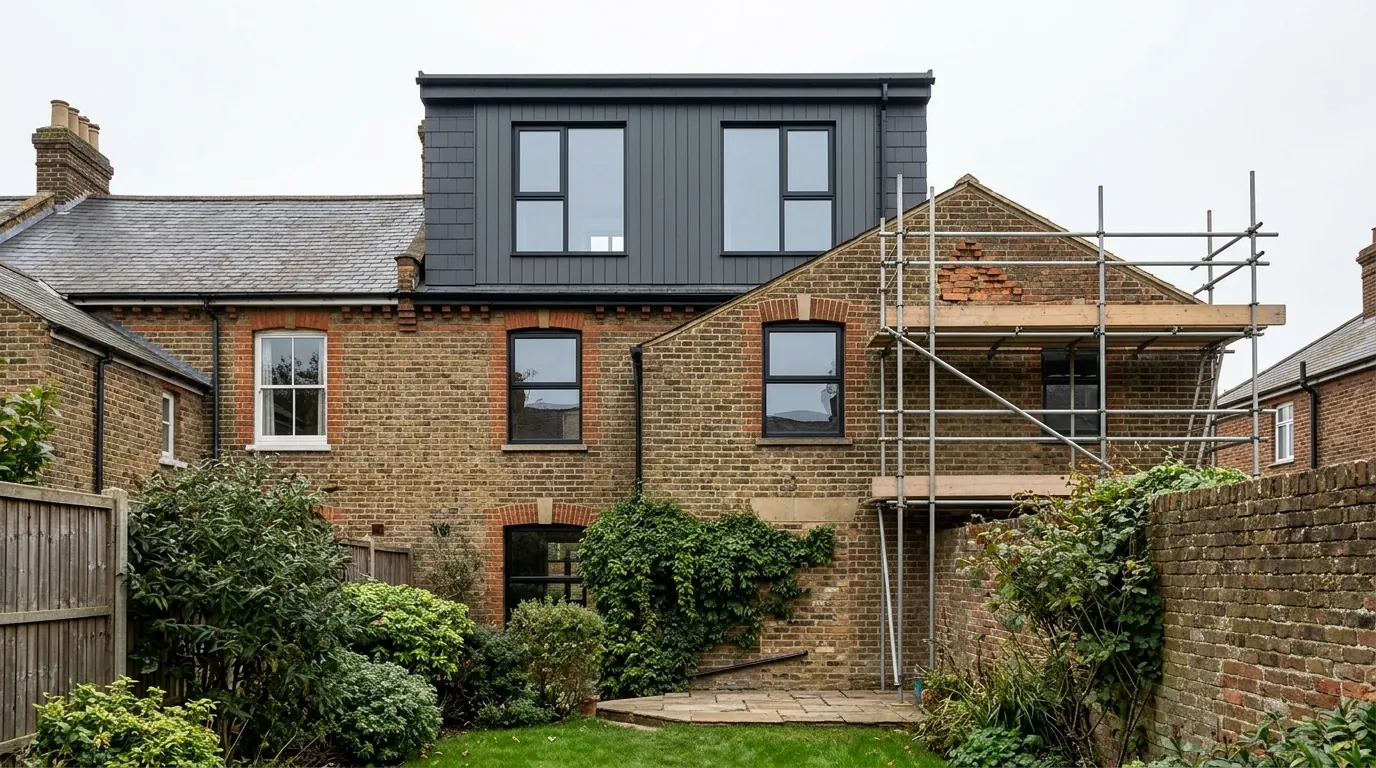
The route back is a regularisation application, which means drawings of something that already exists, opening up so the foundation and the structure can be inspected, and paying to bring anything short up to standard. It is the expensive half of an unauthorised extension far more often than the planning side is.
Two regimes where the answer is much harsher
Unauthorised work to a listed building is a criminal offence from the moment it is carried out, with no notice needed first, and no time limit ever runs in your favour. Work to a tree protected by an order is an offence in the same way. Neither of those is a planning breach in the ordinary sense, and neither should be reasoned about using anything on this page.
Applying for it afterwards
A retrospective application is a real route, and it is decided on exactly the same policy as it would have been beforehand.
You can apply for permission for development already carried out. The application is assessed on its planning merits in the ordinary way, so the fact that it is standing there gives it no advantage and no disadvantage. It is also charged as a full application, and the equivalent certificate for existing work costs more than the one for proposed work.
The awkward part is the decision to apply. Submitting puts the work in front of the council, and if permission is refused you are then in the enforcement conversation you were not in before. That is a judgement to make with advice and with the dates established first, not a reflex, and it usually turns on how visible the work is and whether anyone is affected by it.
Where this actually surfaces
Not on a Tuesday morning with an officer at the door. At sale, when a buyer’s solicitor asks for the permission or the completion certificate and there is nothing to send. What follows is indemnity insurance, a price reduction, a regularisation application at three weeks’ notice, or a chain that falls through, and all of it lands at the worst possible moment.
If you have inherited something unexplained, or built something you are now unsure about, the sequence is the same: establish what was built and when, get the planning history for the address, and find out whether the answer is a certificate, an application or nothing at all.
Enforcement powers and time limits have changed recently and may change again. Check the dates on your own work against the review date at the foot of this page and take advice on the specific facts.
Last reviewed August 2026.
Thinking about the job itself?
Most people who call us already have drawings and permission and want a builder to price the work and build it. Either way the survey and the written quotation cost nothing.